The scope of system governance can be illustrated using gear wheels.
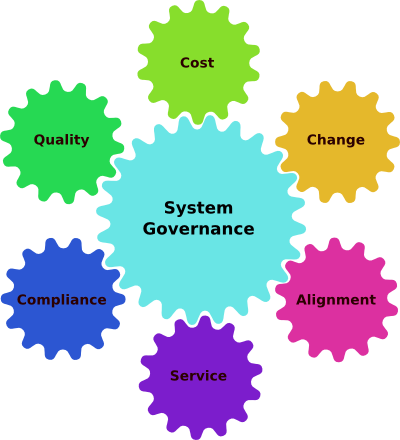
- System governance is a core technique, in the same way that architecture, project portfolio management, and frameworks such as CMMI or ITIL, are core techniques.
- System governance can contribute in many different ways. It can contribute to cost reduction, change management, organisational alignment, service delivery, compliance and quality. You can pick and choose which areas you want to apply it to.
- You can start using system governance in one area, and this helps you apply it in another area. For example, you might start using system governance to manage outsourced service delivery, but doing so helps you managing quality in projects.
- System governance is an ongoing, cyclic process, not a one-off exercise.
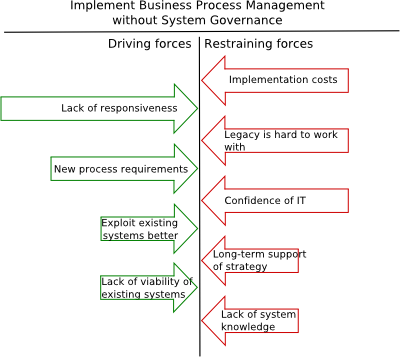
This example shows the forces driving and restraining the implementation of a business process management (BPM) approach to better align IT systems with business requirements and to make IT more responsive.
The main drivers are a lack of responsiveness in IT and a need for new process support. Existing systems could be better exploited, and there is a need to improve the viability of existing systems.
The main restraining forces are cost and the difficulty of working with existing legacy systems. The IT organisation may not be confident to lead business process work. A BPM strategy may not have the long-term support it needs to be a success, and change is hampered by a lack of system knowledge.
On balance, the restraining forces are greater than the driving forces.
System governance changes this picture.
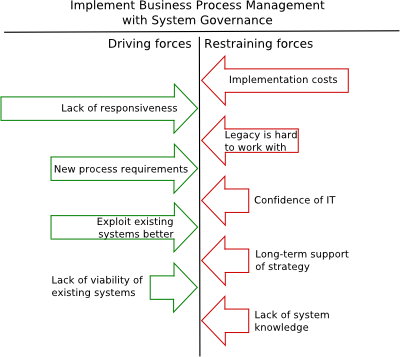
System governance makes existing systems more viable, which increases the driver to exploit them better, but reduces the pressure to increase their viability.
System governance increases knowledge of existing systems, makes them easier to work with, and provides a framework for the long-term support for BPM. System governance demonstrates how well the IT organisation meets existing responsibilities, and builds confidence for contributing to business process management.
On balance, the driving forces are greater than the restraining forces and BPM becomes viable.
We can use different force field diagrams for different situations, to show the different ways in which system governance delivers value. In each case, the contribution of system governance is to strengthen positive forces and to weaken negative forces.
Lastly, the way that system governance works can be summarised as a feedback loop.
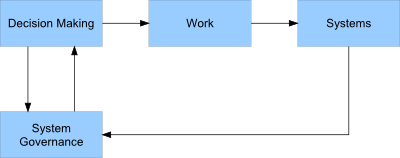
IT decision making - from strategy to design - specifies the work required to implement and change IT systems. System governance completes a feedback loop from systems back to the decision making process, which guides decisions to better manage systems for the long term.
© Copyright 2007 Minimal IT Ltd. See the Minimal IT website for the original newsletter and copyright information.

No comments:
Post a Comment