To solve problems of IT ownership, we need to make IT ownable.
Getting meaningful business ownership of IT is a constant battle. It applies at every level: overall business guidance for IT, in projects, down to individual technical decisions.
Before we blame our business colleagues for ownership problems, we should think whether IT is actually ownable. If IT is not ownable, it is hardly surprising that it is not owned.
We need to consider how we run projects and how we run ongoing IT.
Most IT projects are part of broader business changes. These typically define new business processes, often spanning multiple departments.
We tackle ownership in the project management process. We insist on a project sponsor, to provide a coherent view that IT can deliver against.
We use this coherent view to shape the IT we deliver. Often we deliver a new system to support the new business processes.
This is where the problems start. Different departments may have come together to support a business change, but it does not mean that those different departments are going to merged. Although a single system may meet the objectives of the project, it results in something which has no clear owner once the project is complete.
Ongoing, we aim to deliver high-quality services at low cost. We standardise service delivery processes, and create centres of excellence for different technologies.
These also take ownership away. The decisions on ongoing management are embodied in IT processes and organisational structure.
To make new systems ownable, think about how responsibilities will be divided when the project is finished. Ask this at the start of every project, to guide the structure of the solution. It is OK if different departments are going to merge, or stay separate, or form a joint structure to provide ongoing ownership of the IT, but you must know which.
To make ongoing IT ownable, present IT in a way that business colleagues can relate to and can own.
It you talk about IT processes, organisational structure and technologies, then IT is unownable. Instead, present IT as a catalogue of systems that you manage on behalf of the business. This helps you identify owners for individual systems. It also lets you present the technical and managerial strategy of IT as business-focused principles that every system should achieve, such as continuity of service, regulatory compliance and return on investment.
The combination of a system catalogue and a set of principles is a powerful tool. You can break the principles down to technical and managerial requirements, and consider how each system achieves them. This helps you make IT decisions that can be traced back to business decisions. It helps you have meaningful discussions with system owners. See system quality management for some ideas on a suitable method.
To solve problems with ownership, tackle the underlying problems of ownability. As well ownership of projects, make sure that the systems they produce are ownable by mapping them onto organisational responsibilities. Move discussions about ongoing IT management away from IT's processes, organisational structure and technologies, to a catalogue of ownable systems and general principles.
These changes do not guarantee ownership. But they do make meaningful ownership possible, which is a big step in the right direction.
© Copyright 2008 Minimal IT Ltd. See the Minimal IT website for the original newsletter and copyright information.
Tuesday, 24 June 2008

Tuesday, 17 June 2008
A model of good maintenance
We can learn a lot by looking at excellent examples of long-term maintenance outside IT.
One of my favourite places in the whole world is Bekonscot Model Village. Located in the town where I grew up about 20 miles west of London, Bekonscot is an excellent family attraction. It has an acre or two of detailed, high-quality models showing England in the 1930s. It has model seas and seaside villages, farms and towns. It boasts one of the UK's finest model railways weaving through the villages. It is exceptionally family friendly, relatively cheap admission, and good facilities.
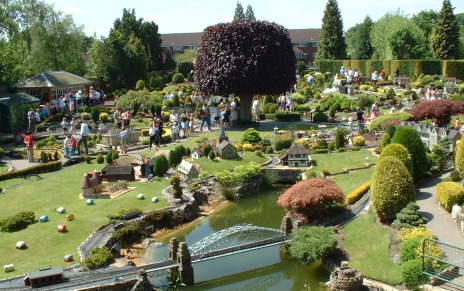
I really enjoy myself every time I go to Bekonscot (which is quite frequently, because my young children love the trains). Even though I visit once or twice a year, there is always something new to see. Models are added and changed, though you never see signs of work in progress.
What impresses me most, though, is that Bekonscot is almost 80 years old. The England it depicts was current when it was founded.
Bekonscot does not show its age. It is one of the best examples of long-term maintenance that I have seen. The models are well-maintained. The trains are reliable. The facilities are clean. The gardens are fresh - the many bonsai trees have not overgrown their surroundings.
The village changes. New models are added, and old models renovated. From time-to-time, it has undergone significant transformations. For example, in the 1990s it stopped trying to keep up with real-world changes, and was remodelled to turn the clock back to the 1930s.
What can we learn from this excellent example of real-world maintenance?
- Things can last indefinitely if you manage them to do so. I have been to plenty of tourist attractions that are managed like typical IT systems - a major development, and then let to run down over the years, before another major redevelopment. Bekonscot is much better for taking the opposite view, and being constantly maintained and renewed.
- Embrace both step change and incremental change. If it needs to change, then change it. Do as good a job as the original developers.
- Work within the structure. If you go to Bekonscot, you don't trip over new buildings in the middle of the paths, or find seaside buildings in model farms. Changes fit into the designed structure, until the structure has to change.
- Take pride in maintenance. The staff at Bekonscot have every reason to be proud of the model village. You can see the pride and enjoyment in the models themselves. If you get down on your hands and knees and peer into the windows of the shops, you can see details and humour that just would not be there if the staff did not really care. I suspect they get a great deal of satisfaction by knowing that they are contributing to an ongoing masterpiece, rather than just meeting project deadlines.
If you get the chance, do visit Bekonscot (especially if you have young children). And have a think about how you could apply their approach to maintenance to the management of IT in your organisation.
© Copyright 2008 Minimal IT Ltd. See the Minimal IT website for the original newsletter and copyright information.
Tuesday, 10 June 2008
That's what I call reuse
You can achieve high levels of reuse if you focus on reusing big things, like whole systems and frameworks. This is much more efficient than assembling from components.
In the past few weeks, I have come across a couple of examples of reuse in my work.
Our Metrici Advisor service supports assessments for broad IT governance and quality management. The same assessment functionality is valuable on a smaller scale, for example assessing risks for a single project, or to evaluate network security controls. We want to create a version of the service for these more focussed assessments. We work through other consultancies, and we want to provide functionality that they can embed in their websites and offer under their own brand.
When we started looking at this requirement, we though it would be a significant development, perhaps using offline forms technology. But after a bit of thought, we realised that we could reuse our existing service with a few modifications. Metrici Advisor has a very clear separation between the user interface and the back-end functionality and follows web standards carefully. Because of this, we have been able to produce an embeddable version of the service in just a few days work (see example of embedded Metrici Advisor). This runs off the same instance of the application and database. We met our requirements by reconfiguring the software to support a new user interface view.
As another example, we had the opportunity to put forward a proposal for some web application development work. It would have taken roughly a year's effort to deliver using traditional web application development in Java.
However, we had a careful look at the Drupal content management system. We realised that we could build the entire application in about one fifth of the time by using core Drupal, add-on modules and customisation capabilities, without writing new code.
These are real examples of significant reuse. What do they teach us?
© Copyright 2008 Minimal IT Ltd. See the Minimal IT website for the original newsletter and copyright information.
In the past few weeks, I have come across a couple of examples of reuse in my work.
Our Metrici Advisor service supports assessments for broad IT governance and quality management. The same assessment functionality is valuable on a smaller scale, for example assessing risks for a single project, or to evaluate network security controls. We want to create a version of the service for these more focussed assessments. We work through other consultancies, and we want to provide functionality that they can embed in their websites and offer under their own brand.
When we started looking at this requirement, we though it would be a significant development, perhaps using offline forms technology. But after a bit of thought, we realised that we could reuse our existing service with a few modifications. Metrici Advisor has a very clear separation between the user interface and the back-end functionality and follows web standards carefully. Because of this, we have been able to produce an embeddable version of the service in just a few days work (see example of embedded Metrici Advisor). This runs off the same instance of the application and database. We met our requirements by reconfiguring the software to support a new user interface view.
As another example, we had the opportunity to put forward a proposal for some web application development work. It would have taken roughly a year's effort to deliver using traditional web application development in Java.
However, we had a careful look at the Drupal content management system. We realised that we could build the entire application in about one fifth of the time by using core Drupal, add-on modules and customisation capabilities, without writing new code.
These are real examples of significant reuse. What do they teach us?
- The most powerful reuse is when you reuse the same application instance for multiple needs. You need to consider ownership issues, but where these are acceptable then it is much better to reuse what you already run than to build new.
- It is more effective to create a single application that can run in multiple modes than to create multiple versions of the same application.
- Structure and standards are critical for reuse. Ill-structured systems that do not comply to standards are harder to modify. If, for example, we used browser-based components in Metrici Advisor, with no clear separation of user interface and back-end functionality, we could not so easily have built our embedded variant (even though we would appear to be using more reusable components).
- It is much more effective to use applications that have plug-ins and customisations than to build new applications from scratch.
© Copyright 2008 Minimal IT Ltd. See the Minimal IT website for the original newsletter and copyright information.
Tuesday, 3 June 2008
Mobile computing - are we there yet?
Mobile computing has become an everyday reality. But we have further to go.
The best test of technology adoption is when you can buy it cheaply on the high street. By this standard, mobile computing is just coming of age.
Mobile computing technology is not new. What is new, though, are the commercial deals that make it cost effective. Up until recently, mobile computing has been prohibitively expensive for everyday use (here in the UK, data rates have been in the region of one pound per megabyte). Recently, however, mobile broadband access has dropped to around the same price as wired broadband connections.
I recently bought a Nokia 6120 from Three to use as a modem for my laptop. The connection is faster and cheaper than the wired broadband to my home. The internet access on the phone itself is OK, though limited by the small size of the screen.
I have been impressed by the service, but I do have some criticisms.
The big leap I want to make is to combine mobile computing with portable applications. I want the convenience of internet anywhere. But I also want to carry all my data and all my applications with me and use them on whatever device I want.
I want to be able to use my applications and data on the phone when I am out and about, and to expand them to run them on a full size screen and keyboard when I stop. I want to run a full variety of applications of my choice, not just a selected few stripped down version for a phone. I want to be able to backup and recreate my environment easily. I don't want a phone that synchronises with my PC; I want a truly portable environment that runs on my phone and on my PC.
Mobile computing has become a financially and technologically viable alternative to fixed-wire connections. We are there or thereabouts with mobile PC connections. But I want more. I want the freedom and convenience of portable applications as well. We aren't there yet.
© Copyright 2008 Minimal IT Ltd. See the Minimal IT website for the original newsletter and copyright information.
The best test of technology adoption is when you can buy it cheaply on the high street. By this standard, mobile computing is just coming of age.
Mobile computing technology is not new. What is new, though, are the commercial deals that make it cost effective. Up until recently, mobile computing has been prohibitively expensive for everyday use (here in the UK, data rates have been in the region of one pound per megabyte). Recently, however, mobile broadband access has dropped to around the same price as wired broadband connections.
I recently bought a Nokia 6120 from Three to use as a modem for my laptop. The connection is faster and cheaper than the wired broadband to my home. The internet access on the phone itself is OK, though limited by the small size of the screen.
I have been impressed by the service, but I do have some criticisms.
- Pricing isn't as plain and simple as it could be. I had a lot of fun asking customer services what the difference is between their "mobile broadband" and "mobile internet" offers. I am constantly reminded of Scott Adams' (of Dilbert fame) description of phone companies as a "confusopoly" - maintaining their position by confusing their customers.
- On the phone itself, the Internet is not as open as it should be. The internet applications - email, Skype, MSN Messenger - are more restricted than their PC counterparts. It has taken me some time to break out of the walled garden of "specially selected content" that my provider imagines I might be interested in.
The big leap I want to make is to combine mobile computing with portable applications. I want the convenience of internet anywhere. But I also want to carry all my data and all my applications with me and use them on whatever device I want.
I want to be able to use my applications and data on the phone when I am out and about, and to expand them to run them on a full size screen and keyboard when I stop. I want to run a full variety of applications of my choice, not just a selected few stripped down version for a phone. I want to be able to backup and recreate my environment easily. I don't want a phone that synchronises with my PC; I want a truly portable environment that runs on my phone and on my PC.
Mobile computing has become a financially and technologically viable alternative to fixed-wire connections. We are there or thereabouts with mobile PC connections. But I want more. I want the freedom and convenience of portable applications as well. We aren't there yet.
© Copyright 2008 Minimal IT Ltd. See the Minimal IT website for the original newsletter and copyright information.
Subscribe to:
Posts (Atom)