Specialists have an important role lighting up the dark corners that management can not see.
There is a lot of truth in the phrase "You can not manage what you can not measure". You need to be able to discern good outcomes from bad.
Also, you can not measure what you can not define. You need to know where one thing ends and the next thing starts. You need a mental model to know what it is that is good, and what it is that is bad.
But in a self-referencing twist, how you define the world largely depends on how you manage it. Your approach to management imposes a structure on the world, which dictates how you define and measure it, which then impacts how you manage it.
To manage as best we can, we use structures that match the main needs of the work. In IT we tend to structure the world into development activities split by project, and service delivery activities split by role.
Whatever structure you use, though, there are always limits to what you can manage. Even the best managers have blind spots.
Often we use specialists to fill in the gaps that the main structure does not cover. For example, if most of the work is organised as projects, we will have specialists looking at different technical areas.
We generally think of specialists as supporting the main structure, for example providing technical expertise to projects. But a major value of specialists, and one that we should value, is that they take a different viewpoint from that of the main management structure and can see things that management can not.
Often this leads to conflict. In its mildest forms, specialists are seen as a bit over-zealous, for example a database administrator going on about database standards. In its more severe forms, specialists are seen as undermining management. When I worked as an enterprise architect, I would raise comments on projects' fit to the overall architecture, but these were incomprehensible to the dominant project management structure which only thought in terms of project delivery, and I was seen as unhelpful and working against management.
Whether you are working as a manager or a specialist you need to navigate this. One way is to superimpose an additional structure over the work to support a common viewpoint. This shared structure has to be very simple. You will not be able to get a common viewpoint if you use a consolidated work plan, or an enterprise architecture, or a set of ITIL processes.
I use a simple structure of "systems", where a system is a business application, and the software, hardware and human processes that support it. I embellish this with "qualities" that represent the valuable things we have to achieve. Most different IT viewpoints can be mapped to this structure, and it can be used to explain the issues that different viewpoints encounter.
Whatever simplified structure you use, it will always be thought of as inferior and less relevant than detailed management and specialist structures. But it is not there to replace other structures. It is there to provide a forum to combine multiple viewpoints, and let specialists light up the dark corners that management can not see.
© Copyright 2010 Minimal IT Ltd. See the Minimal IT website for the original newsletter and copyright information.

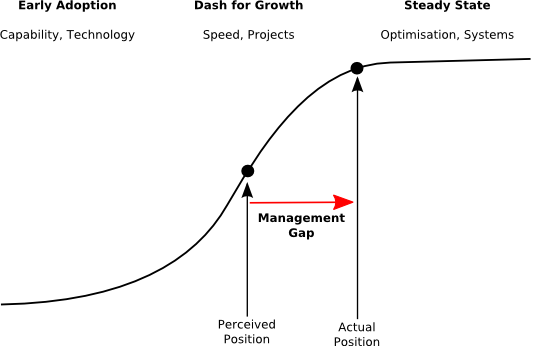
Most organisations have moved on from managing technical capability, to using projects to deliver changes as quickly as possible.
In reality, though, most organisations have matured even further. Most work in most projects involves replacing functionality, not delivering new functionality. Our management approach has not kept up, and we are still managing a dash for growth. To maximise the value from our investments in IT, we now need to change our management approach.
We need to present IT differently. During the dash for growth, there was a lot of opportunity for totally new IT. It was appropriate to use relatively simple and even emotive arguments such as "information is the life blood of the organisation" to argue for IT.
Now that IT is more mature, and the general case for IT has been made, we need much more precise discussions about optimising the use of IT, to separate truly valuable use from gratuitous use. We need more rigorous analyses of the business value of information, and the ongoing costs of using, running and maintaining IT. We may need to dampen the enthusiasms of our business colleagues for systems that can not deliver value. A down-to-earth view of IT, as a capability to automate the storage, transformation and communication of information, can help us understand value more precisely.
The main IT management focus needs to alter, too. When the emphasis was on growth, it made sense to structure much of IT management (and career structures) around projects.
Now that IT is more mature, we need to focus on the IT that we already have. We need to shift attention to the ongoing management of meaningful business systems, rather than overemphasise big changes. We need to move on from projects that implement new IT to incremental changes that continuously realign what we have to where business is going.
At a more detailed level, we need to design and develop systems to be long-lived and easy to evolve. We need to choose technology that can last a long time, and use it so that it can. We need to value standardisation more than productivity.
We need to design in a way that makes systems easy to work with. We need modular designs, but not so intricate that nobody other than their original developers can understand them. We need to adopt methods of connecting systems that emphasise ease of independent change, rather than development speed. We need to pay more attention to documentation and testing, because these are much more important when systems are long-lived.
Regular readers will recognise these themes: demand reduction, precise definition of IT value, system focus, incremental change, standards, simple design, decoupled integration, documentation, and testing. These are not as exciting as technology and projects, but they are what we need. We need to move on from our obsessions with yesterday's problems, and use these to tackle tomorrow's.
© Copyright 2010 Minimal IT Ltd. See the Minimal IT website for the original newsletter and copyright information.